Gathering Heritage Voices

An investigation into Bristol's multi-cultural heritage through song and spoken word

Bristol is a 21st century multicultural city and the ‘Gathering Heritage Voices’ project has been an investigation into our cultural heritage through the medium of song and spoken word. ‘WorldRoots Voice’ (age range 13 and up) is Bristol’s foremost youth acappella ensemble, performing songs from across the world. This group agreed that the time had come to collaborate with other young people, musicians, singers and heritage organisations to explore issues of diversity and heritage. This fascinating and rewarding process of collaborating, gathering, learning, recording and performing a rich mix of songs and stories has resulted in a recognition and celebration of the city’s vibrant, vital and diverse heritage. By talking with, interviewing, sharing songs, learning from and performing with musicians from diverse places such as Cameroon, Portugal, India, Zimbabwe, Bulgaria etc, the teenagers from WorldRoots were able to gain valuable insights into the rich cultural heritage of their own city.
The fourteen month project included:
Song sharing & skills workshops with WorldRoots
International musicians working in local schools
Rehearsals for live work
Performances for audiences
CD Recording Sessions
Video interviews & photographic documentation
CD & DVD production
The Gathering Heritage Song Book
The songs that you will find in this book and on the accompanying CD were shared and taught orally by the musicians that we met along the way. This is the way we prefer to work and sing, allowing the songs to find their own place within each of us, often a process that doesn’t seem to have much to do with our brains but more to do with a body knowledge. This is how songs and stories have been passed between peoples across the globe for generations and in this way we feel we gained far more than just another new set of songs, but that we have made many new and lasting friendships by allowing ourselves to be open to these unique and exciting experiences. We would like to thank all the people that helped Gathering Voices and WorldRoots Voice make this Heritage Voices project so successful. We are obviously especially grateful to the Heritage Lottery Fund for their support and to the Regional History Centre for helping us to research the pattern of migration into Bristol in the last 60 years. We hope that this resource proves to be an enjoyable and useful beginning point for your own journeys into the songs and stories that are brought to Bristol by those that find themselves, by choice or otherwise, living here from around the world.
Quotations from project participants:
“Being involved in the Gathering Heritage Voices project has really opened up my views to so many different cultures, especially here in Bristol where we have such a mix. It’s been so interesting learning the songs and the interviews have especially helped us learn so much about their lives.”
“Meeting musicians from around the world who now live in Bristol has been brilliant and learning and sharing songs together has been a fantastic experience!”
“What I’ve learned really, is that it’s about seeing how rich our society can be and how people from different countries add their own special mix of spices into the heritage of the city and make it into the beautiful cuisine that is our culture.”
“I thought I knew quite a lot about the music in my own city, but meeting all these amazing musicians and singers has really made me appreciate that it’s all so much richer, with so many different cultures making up the history of the city.”
A message from Gathering Voices:
As an independent arts charity specialising in global musical cultures, Gathering Voices recognise the importance of increasing young people’s knowledge of issues relating to their rich cultural heritage. The grant awarded to us by the Heritage Lottery ‘Young Roots’ Fund has meant this youth focussed project was able to hold a series of meetings, interviews, recordings and song and skill sharing sessions with many singers and musicians from other countries.
We feel that this form of cultural exchange and interaction is both educational and vital in creating understanding, unity and cultural cohesion and both the process and evidence gathered provides a valuable insight into the richness and diversity of Bristol and the wider UK.


Track 1: Sisters now our meeting is over - sung by Gathering Voices' NewRoots Choir
This is probably a Quaker hymn and can be found with many variations in the words


Track 2: Chula moma jatva i se razboliala - courtesy of Vesko Samuilov & Ivinela Samuilova (www.bgfolklore.webs.com) Humourous Bulgarian song about Harvest time sung whilst working

Bulgarian Folk Music is defined by some musicologists as “a mystery” because of its uniqueness of highly irregular rhythms, rich complex harmonies and glorious polyphonic sound.
Vesko and Ivinela – a father and daughter from Bulgaria brought together their love for that “mystery” and undertook the mission to promote Bulgarian Folk Music and to share this world-famous musical heritage to more people.
Vesko Samuilov is a musician with 40 years of experience and a musical director of several folk choirs in Bulgaria. Besides his work as choirs’ leader, Vesko is searching for and collecting authentic and unknown to public folk songs with the purpose to notate, publish and thus preserve this unique music for the generations ahead.
Ivinela Samuilova has inherited her father’s love for music. Watching his dedication to preserve and popularise the folk music and realising the invaluable worth of his work, Ivinela established a Folklore Centre as part of the activities of her Foundation in Bulgaria. Among the activities of the Folklore Centre are: Bulgarian Folk Music Cultural Holidaysfor Foreign Choirs, Folklore Cultural Exchange Camps for Youth Singing Groups, Folk Singing Groups Concert Tours Exchange and Workshops on Bulgarian Folk Singing for Choirs abroad.
Vesko and Ivinela visit the UK giving workshops in Bulgarian Folk Singing to adult community choirs, youth singing groups and students. Their future plans include not only touring other countries but also attracting foreign singers to Bulgaria where they would be able to learn Bulgarian Folk Singing inan authentic environment and to get a first hand experience of Bulgarian culture and traditions.

Track 3: Tue Tue - sung by Gathering Voices' NewRoots Choir
Ghanaian harvest song

Track 4: Chanda Mama - sung by WorldRoots Acappella (with musicians Dildar & Jeevan of RSVP Bhangra https://www.rsvpmusic.co.uk) Hindi lullaby from India
Chanda-mama means “moon uncle”. Moon is considered masculine in Hindi, and children are told that the moon is like an uncle.


An interview with Dildar and Jeevan by WorldRoots Acappella
What is Bhangra and where did it originate?
Bhangra music comes from North West India, from Punjab region, and it’s kind of a harvest festival dance, used by a lot of Punjabi’s. How important a part do you feel music has played in your life?
Music is a part of every facet of my life in terms of when you’re happy, when you’re sad, when you’re doing things, when you’re serious, when you’re not serious. I’ve always got a phrase for something, you know, one particular song I keep on singing over and again and its in Urdu. It says that there are more other pains in life than the pains of love.
How important do you think it is for young people to learn music from different cultures?
I think it’s extremely important because it gives that diverse perspective of the world, our lives as young people, the way we see the world is the same but the way we approach things are different. Diversity is learning - if we have a monochrome vision, it doesn’t really help us to see the full spectrum of life. The full spectrum of life is colourful and diverse and different and through that difference is how we learn and develop and grow. Otherwise we would be like little squares, you know, mass produced by the Good Lord. But the Good Lord was such a creative person, he’s made creativity at the soul of man and woman, humankind. So diversity is really key in all aspects of our life – for me. How would you say that this music could continue to spread and grow in today’s society?
It’s already started, in this generation you have mainstream Asian artists who are actually on Top of the Pops now.The music has become global, it’s become fused, it’s well acknowledged globally and now what’s going along with it is the kind of internationalism around Bollywood and Bollywood dance and movies.
So does it please you to see how it’s grown?
Yes, it’s pleased me to see how much it’s evolved andhow much I can actually be involved in it. I don’t think even 10 years ago I would have thought it, me going into a mainstream audience and enjoying teaching and sharing and actually having a two way dialogue. I’ve found it very, very interesting today. I’ve learnt lots and lots of good things today and feel privileged, so thank you for this wonderful workshop.
How important would you consider it to carry on the oral folk tradition of Punjabi music?
In order to keep that music going, and it will evolve, someof our parents don’t recognise it, but in essence it is the same thing. Time is ever going on so the stories you tell your children, your great-grandchildren, your legacy of your being, who you are, what you’ve done, where you’ve been, where you’re going, that wisdom will be told orally through stories and song. I’m sure I’d like to think in years to come that wherever I am, I’m looking at you as an old lady, teaching your great-grandchildren, that you have heritage and culture moving on.
Track 5: Siyobona - sung by WorldRoots Acappella
Shona funeral celebration song from Zimbabwe


An interview with Cecilia Ndhlovu by WorldRoots Acappella
My name is Cecilia Ndhlovu. I come from Zimbabwe.I came (to England) 8 years ago. I’ve been always involved in music and dancing, I was talented as a young child. At primary school I was in my school choir and the traditional dance (group) and then at secondary school I was in the traditional dance group. One daya group called Black Umfolosi, they are very popular back home, called me and asked me to join their latest troupe for dancing.
I was really excited and we were going to go to Spain, rushing everything to get a passport - in Zimbabwe it’s so difficult to get a passport, in those days it could take a year or two to get a passport, now they don’t have them any more. They say there is no paper to make the passports and even the money they don’t have it in the banks. I was the best dancer but unfortunately the group had to leave without me because I couldn’t get my passport on time. It was really sad.
When they came back I continued working with them until one day a guy called Oliver Mtukudzi, I don’t know if you know him, if you Google him on the internet he is a legend of music in Zimbabwe, he came to my area where I grew up in Bulawayo and when he was playing Black Umfolosi was going to be his curtain raiser. So we were there and then I started chatting to one of the girls who was like ‘guess what, we are looking for somebody in the band... but Oliver is a tough guy so my advice to you is to just gate crash on the stage and show him your talent’. So I went to watch their gig and then in the middle of the session I just went on stage and played the Congas and I was singing the wrong words but to the right tune and I was dancing and I was like everywhere. Oliver was like ‘I really like her, can you call her to come to the studio on Monday?’, I had never been in the studio before, and everything was just amazing! I wasn’t thinking about money, that I should get paid or anything, I was just excited to be near Oliver and seeing him sitting there and I am sitting here and we are talking and I am like ‘oh my God!’ and then we recorded the first album that same week and I was paida lot of money - at that time it was loads of money. He paid me 300 Zim Dollars, it was like pocket money for that time,it wasn’t the studio fee, the studio fee came up later. And the excitement because I didn’t come from a rich family andI wasn’t looking forward to getting a job any sooner, so it was like a dream to me, it was so exciting. In 2000 we recorded a song called Bvuma, it means ‘tolerance’... that was the time when MDC was coming up very strong, MDCis the opposition party of the Zanu-PF in Zimbabwe... the song was declared as a political song... so we started getting a lot of trouble. The first time they took Oliver away in the middle ofthe show... and the second time they took the whole band for questioning. That time I was taken while I was coming from the Stadium, driving home. Unfortunately, I was wearing the Oliver Mtukudzi t-shirt with the label of the new album. Before they asked anything they asked my ‘Why are you wearing that t-shirt?’ I said because I work with the band and they said ‘Yeah, we’ve been looking for you people, can you get in the truck, we want to ask you a few questions’, ‘Why, what have I done?’. They said ‘You are just coming from the gig aren’t you, so get in the truck’. And they took me till the morning. Things were becoming very tough those days, it was becoming really tough, so that’s when I decided to leave. (When I first arrived in England) I stayed with my friend in London, it was tough. She didn’t explain to me how people live in this country, everything was so strange to me. I didn’t know where the shops are, I just thought everyone is mad because they are so rushing and everything was too fast for me and to really believe that I have left my home and I have come here, it was difficult to accept. For a few times I nearly gave up and went back, but something kept me going. I haven’t spent a Christmas with my family for years... it’s been maybe 15 to 16 years I haven’t spent Christmas with my family. So I hate Christmas now because every time it comes I see other people buying presents. The only present I can get is one for my sister - I’ve got one sister here and a few friends that I’ve met in Bristol, but I don’t really like it any more, any celebrations. I booked the ticket and came to Bristol. I went to the Refugee Council, I was referred to the Asylum Team of the Social Services and I met a lady, she was a musician, Lorraine, and she was telling me she was a musician and I said ‘oh I sing as well’, so I rushed home, took some CDs from Oliver Mtukudzi and gave them to her and a video that we’d made in America. After watching that she was so amazed and she said ‘look, here is so and so’s number, phone them, I want you guys to work together and write a song about Refugee Week’. So we practiced and practiced and practiced and we got a song and then the first Refugee Week I went to was 2005, that’s when I met all other musicians. At the Refugee Week I met these two ladies, Deasy and Siobhan... they invited me to Tribe of Doris, they said you come as a volunteerthe first year, see if you like it, and then next year we might give you a job and I am like ‘wow!’. So, I started working with Tribe of Doris and have been getting jobs from them and I’ve met every musician in Bristol and every dancer in Bristol. I know them and they know me. So Bristol is like home for me.
I play as an ambassador of Zimbabwe, every time I have to do something like this it is not money that I think about first, it is me and where I grew up and how I am keeping my culture and my talent and everything God made me to be going.
Track 6: Belle Mama - sung by Gathering Voices' NewRoots Choir A song in praise of mothers from the Torres Strait Islands
The languages of the Torres Strait Islands are related to the indigenous languages of the Australian mainland.

Milho Verde (José Afonso) - sung by WorldRoots Acappella
A harvest song from Portugal


An interview with Claudia Aurora da Silva by WorldRoots Acappella
I was born in Portugal in Vila Nova De Gaia, just opposite from Porto which is the second biggest city of Portugal, after Lisbon of course. I was brought up on a kind of a farm, my grandfather is a farmer, they raise pigs and cows and lots of fruit trees and so I grew up in a very green environment with a very traditional family where we eat all the traditional meals and we are very keen with our food, with our fish, with our meat. A very united family, because families in Portugal are very united. We enjoy mainly gathering together eating lots constantly and having fun.
Do you think it’s valuable to learn about the music of other cultures? I think that it’s very valuable to learn music from other cultures because you will broaden your horizons, it will bring you different perspectives, you will understand a bit more about how the rest of the world lives and not just focus on the English culture or the American culture. Even if you don’t understand the language, it brings elements that it will help you to understand other people as well and others points of view and respect other musicians
as well. Coming out from this Pop factory that can be quite damaging, as you all know, I think it can be quite damaging. What difference do you think that music makes in people’s lives, what’s good about having music in your life? I think that music brings healing to people’s lives,it brings answers, it heals lots of wounds I think. It brings excitement, it brings happiness, it brings what it needs to bring in the moment. It’s a very important thing, music, and when I speak about good music that’s general, involves all sorts of styles. I was 8 years old when I started becoming reallysensitive to music, start with American music like Bruce Springstein, Bob Dylan, because it was what my father had in the house. I stared listening to it and then I grew up and started going to Rock like Led Zeppelin, big bands. And then when I found my voice, I was about 18 when I discovered I had voice skills, or the confidence to accept that I had voice skills and then by 19 I started to listen to Bosa Nova and Brazilian music and world music in general and I started to explore my ability with Bossa Nova and I started singing with a few local musicians, forming a local band. So it all started a big enthusiasm towards world music. Only in my mid-twenties I realised I could sing Fado, the music from my culture, from Portugal. Why are you a professional musician nowadays? I am a professional musician because it’s in my heart, it’s my talent, it’s what I feel life is pushing me to do. So I’m doing it at the moment while I still have the strength and the voice and hopefully it will just become better with time. Do you find it difficult living away from home? Yes, but I think I’m quite adaptable myself. I know, I meet with loads of Portuguese people who are constantly moaning about England and the weather and I moan as well, sometimes, but because I’m so busy doing my things I don’t have time to be in the sun enjoying myself, I need to work, so I don’t miss it. I miss some elements of it, like I said the food and the friends and there’s a way of living there very different from here, but there’s other sides I don’t really like and the lack of opportunities I don’t like as well. I think Bristol, in this case is the only city I can speak about in England, is open, is quite open for what I want to bring. So that doesn’t make me miss as much my country, because I’m busy doing what I like, you know?
Song 8: Dene mari
A humourous Bulgarian song to be sung whilst working

Song 9: Tele Mani
A Congolese gathering song

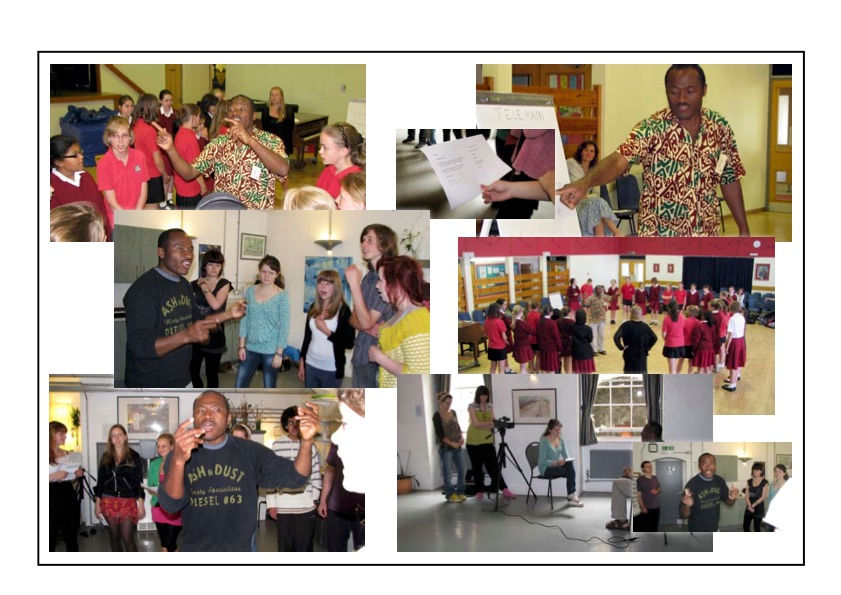
An interview with Alphonse Daudet Touna by WorldRoots Acappella
The culture I grew up is Cameroonian culture because that’s where I’m born. I’m born in a very little tiny village, very small village. Everybody knows, Africa is not quite developed, it’s not like here. We have some villages with no electricity, where we have to go miles away to school. My village is called Siliyegue, it is 60 miles from the capital, Yaoundé.
My childhood was a little bit, not sad, but there was a lotof solitude in it, because I am the only son in my family so I grewuponmyowninmyfamily. SomyDadandmyMumhad only me but at the same time you have some other houses around, they have so many children, 9 children, 10 children, 8 children and I was only one. It was quite interesting!
Can you tell us about your balafon making?
As an artist, I’m not just a singer, I make musical instruments, I design different styles of musical instruments and drums, marimba, mbira, this kind little thing. But my main instrument, I like myself more, is marimba/balafon. Like today I try to make a xylophone with 2 keyboards, so that you can use that in many different ways, to play with any band. I also teach how to play that and you are welcome to learn if you want!
How was music first introduced into your life?
My Granddad used to play kind of musical instruments called tam tam, that’s normally what we call African telephones. It’s a big trunk of wood, hollow inside, so you play that with two sticks, then you send messages. He was all the time announcing, sending messages to many different people, different villages, he used to use that for different occasions, sometimes when maybe a funeral is happening or wedding or other community events. I also saw many different people playing xylophone, balafon, marimba, things like that, singing, dancing – that’s how I start to listening to music. It wasn’t really my thing, it took me time. The African tradition, African culture, we don’t take seriously sometimes this kind of thing because your parents would like to see you becoming clever, being a doctor instead of playing music, when you are singing or playing music you can’t make enough money, you can’t make a living through it. So your parents don’t encourage you too much.
How important do you think it is that cultures are mixed through young people?
Today the civilisation has been transformed a lot. We are inthe 21st century, so a lot of things have changed, ideologies and the way people are thinking, people are travelling everywhere, people are mixing, meeting each other. But the danger of that is that sometimes we can loose our heritage, but it is important to keep our heritage with us. My role for example, in Cameroon and here, is to preserve this heritage to pass that on. I’m abit sad that maybe people are disappearing and we are loosing this heritage and really what I would suggest, I would advise young people today, try to approach any person to find out who he is, where he’s coming from, what’s his culture, and just try to share that. This exchange is important, it will create more understanding, more openness and respect among people.
Song 10: Bakhtrionidan Gitskerdi
A circle dance - love song from theTushetian Region of Georgia

Featured Musicians and links to further useful information:


